How Can I Safely Use ChatGPT to Research a Health Problem Before Seeing My Doctor?
Use ChatGPT to understand health questions, check medical claims, protect your privacy and prepare better questions for your doctor. A practical guide for adults 60+.
About 15 minutes to read
How can I safely use ChatGPT to research a health problem before seeing my doctor? As a Retirement Futurist helping adults 60+ navigate AI, my advice is to use ChatGPT to understand medical information, organize your concerns, and prepare better questions, while checking important claims and keeping medical decisions with qualified professionals.
This is one of the most promising everyday uses of artificial intelligence. It is also an area where we need to be especially careful.

Imagine having a health concern, waiting for a medical appointment, and wanting to understand what might be happening. Perhaps you have an unfamiliar symptom, an unexpected blood test result, or questions about a treatment your doctor has suggested.
In the past, you might have spent hours searching the internet and sorting through conflicting information. Today, you can have an extended conversation with ChatGPT, ask follow-up questions, and request explanations in ordinary English.
But there’s a catch: ChatGPT can sound knowledgeable even when its answer is incomplete, misleading, or wrong.
The real opportunity is learning to use AI as a health research assistant without treating it as your doctor.
What can ChatGPT actually help you do with a health concern?
I see five particularly useful applications for adults in their 60s, 70s, and beyond.
- Understand medical language. ChatGPT can explain unfamiliar terms in a doctor’s report or medical article. You can ask for a simpler explanation and keep asking until you understand.
- Organize symptoms. It can help you put your observations into a clear timeline, including when symptoms started, what makes them better or worse, and how they affect your daily life.
- Explore questions worth asking. Instead of offering a diagnosis, it can help identify possibilities and uncertainties that a clinician may want to investigate.
- Understand treatment choices. It can explain general benefits, risks, and alternatives, giving you a starting point for discussing a clinician’s recommendations.
- Prepare for appointments. Perhaps its most immediately valuable application is turning a confusing collection of concerns into a short, organized set of questions.
None of these tasks requires AI to make the final medical decision. And that’s an important distinction.
The World Health Organization recognizes the potential of generative AI in health while warning that inaccurate, incomplete, and biased responses can cause harm.
So how do we obtain the benefits while reducing the risks?
First, is this a health question that can safely wait?
Don’t use ChatGPT in place of emergency care. Sudden chest pain, severe difficulty breathing, stroke-like symptoms such as sudden weakness or difficulty speaking, sudden confusion, and other serious warning signs require urgent medical evaluation.
Don’t spend valuable time questioning a chatbot when emergency care may be needed. The MedlinePlus guide to recognizing medical emergencies explains warning signs that deserve immediate attention.
For new, persistent, worsening, or unexplained symptoms, contact a healthcare professional rather than relying on ChatGPT to decide whether an appointment is necessary.
For non-emergency concerns, however, ChatGPT can be a helpful place to organize your thinking.
My approach: Learn. Verify. Apply.
At Retirement Singularity, my broader approach to navigating technological change is Learn. Verify. Apply. I believe it works particularly well when researching a health concern.
Research health questions with AI: a three-step map
1. LEARN
Understand the issue. Ask about possible explanations and missing information, not an AI diagnosis.
2. VERIFY
Check important claims. Open reliable medical sources and read what they actually say.
3. APPLY
Prepare for your visit. Bring a concise summary and better questions to your clinician.
AI helps you prepare. A qualified clinician handles diagnosis and treatment.
1. LEARN: Ask AI to help you understand the problem
Start with a clear description of what you want to learn. You don’t need to provide your name or identifying medical details.
Suppose you’re experiencing recurring stiffness in your hands. Rather than asking, “What disease do I have?”, try:
Prompt to copy:
I’m an older adult experiencing recurring stiffness in my hands, especially in the morning. Help me understand what general factors a doctor might consider. Explain the possibilities in plain English, tell me what additional information would be useful, and identify warning signs that would require prompt medical attention. Do not diagnose me.
Notice what this prompt does. It asks for possibilities rather than conclusions. It requests information about what might be missing. And it makes clear that you want to prepare for professional evaluation.
You can then continue the conversation:
What questions should I expect my doctor to ask, and what observations could I record before the appointment?
Or:
Explain the difference between these possibilities without assuming that any of them applies to me.
This conversational process can help you become more informed without pretending to replace a medical examination.
2. VERIFY: Check the answers before believing them
This is the step I consider most important. ChatGPT is very good at producing fluent explanations. Unfortunately, fluency is not evidence of accuracy.
When the answer could affect a health decision, check it against reliable, independent sources. A useful follow-up prompt is:
Which important claims in your answer need verification? Find current, reputable medical sources supporting or challenging them. Clearly separate established medical knowledge from preliminary research, and tell me what remains uncertain.
Then actually open the sources. Don’t assume a citation is correct just because ChatGPT provides one. Verify that the source exists, that it says what ChatGPT claims, and that the information applies to the question.
I recommend starting with sources such as MedlinePlus, operated by the US National Library of Medicine, relevant national health agencies, recognized medical associations, and established medical institutions.
Four questions worth asking about any significant medical claim:
- Who is the source? Is it a recognized medical or scientific organization?
- How strong is the evidence? Does it come from established clinical guidance, a substantial human study, or early research?
- How current is it? Could the guidance have changed?
- Does it apply to me? Were people with similar ages, conditions, and circumstances included in the evidence?
The National Library of Medicine’s guide to evaluating health information is an excellent resource for developing these habits.
One particularly important point: a study showing promising results in animals or a small group of people does not necessarily establish that a treatment is safe or effective for you. And even a medically accurate general statement may not apply to your personal circumstances.
3. APPLY: Turn your research into a better medical conversation
Once you’ve learned about the issue and verified the important information, the next step is not to diagnose or treat yourself. It’s to prepare for a more productive conversation with your healthcare professional.
Try this prompt:
Based on our discussion, help me prepare a one-page summary for my doctor’s appointment. Include my main concern, the symptom history I’ve provided, information I should bring, five prioritized questions, and anything that remains uncertain. Do not include an AI diagnosis or invent information.
Review the result carefully. Remove anything inaccurate, speculative, or unnecessarily complicated.
A well-prepared appointment summary might include when symptoms began, how they’ve changed, their effect on daily activities, and your biggest concern.
You should also bring an accurate list of your medications and supplements, including doses, using your own records rather than relying on AI to reconstruct it.
The US National Institute on Aging recommends preparing questions and prioritizing concerns before medical appointments.
I’ve also created a free, one-page Medical Appointment Questions worksheet that you can print and bring with you.
How do you protect your medical privacy when using ChatGPT?
Medical information is among the most sensitive information we possess. Before entering health details into any AI tool, consider what is truly necessary to answer your question.
You can often learn a great deal without supplying your full name, birth date, address, health insurance number, medical record number, or identifying documents.
For example, rather than uploading an entire laboratory report, you might begin with a general question about what a particular test measures.
If you decide to share actual results, first review the service’s privacy settings, remove unnecessary identifying information, and consider whether you are comfortable sharing that information with the provider.
Three privacy considerations deserve special attention.
- Model training: In personal ChatGPT accounts, OpenAI provides a setting called Improve the model for everyone. You can turn it off under Settings > Data Controls so new conversations aren’t used for model training.
- Temporary Chat: ChatGPT also offers temporary conversations that don’t appear in normal chat history and aren’t used to improve its models. However, OpenAI says copies may be retained for up to 30 days for safety purposes. A temporary chat is not the same as a guarantee that no information is retained.
- Connected tools: Custom GPTs, plugins, and external services may have additional data-sharing arrangements. Check which services receive information before using them with private health details.
OpenAI explains these distinctions in its Data Controls documentation. Specialized health features may offer additional protections, but their availability and rules vary. Don’t assume every AI chat or third-party health app has the same safeguards.
My preferred starting point is simple: share the minimum information necessary, especially while you’re learning how a tool works.
A real-world example: Preparing for a doctor’s appointment
Let’s imagine a hypothetical situation.
Margaret is 70, retired, and lives in Halifax, Nova Scotia. For several weeks, she has noticed stiffness in her fingers when she wakes up.
Her doctor can see her in two weeks. The symptoms aren’t severe, but she wants to understand what information might be helpful.
Instead of asking ChatGPT for a diagnosis, Margaret begins with a general explanation of hand stiffness. ChatGPT describes different factors a doctor might consider and suggests questions about the timing of the symptoms, swelling, medication history, and effects on daily activities.
Margaret then checks the main medical claims using reputable health websites. She starts a simple record of what she notices each morning.
Before her appointment, she asks ChatGPT to organize her observations into a short summary. When she meets her doctor, she can clearly explain what has changed and ask focused questions.
The doctor examines her, considers her complete medical history, and determines the appropriate next steps.
The important outcome isn’t that ChatGPT identified a condition. It’s that Margaret arrived better prepared to participate in her own healthcare. That’s the kind of practical benefit I’m interested in.
What about using ChatGPT to understand blood tests and medications?
These are two of the most useful applications, but also two that require extra caution.
Understanding blood test results
ChatGPT can explain what a laboratory measurement generally means, why doctors order it, and which factors may affect interpretation.
But a single result doesn’t tell the whole story. The relevant reference range, your age, medical history, symptoms, previous results, and the reason the test was ordered can all matter.
Try asking:
Explain what this blood test measures and what factors clinicians consider when interpreting it. What questions should I ask my doctor? Don’t decide whether my personal result is normal or abnormal without the necessary context.
Use the actual laboratory report and your clinician’s interpretation for decisions, not a chatbot’s conclusion.
Understanding medications
ChatGPT can also explain how medications work, common side effects, and general categories of drug interactions. However, it may overlook an important interaction, invent one, or miss a factor specific to your situation.
For medication safety, a pharmacist or prescribing clinician should verify the information using appropriate references and your complete medication list.
Never start, stop, combine, or change the dose of a medication solely because ChatGPT suggests doing so. The same caution applies to supplements, including those promoted for longevity.
What are the biggest mistakes to avoid?
One common mistake is asking AI to confirm what you already suspect.
For example, if you’re convinced that a symptom is caused by a particular condition, repeatedly asking ChatGPT to support that theory can reinforce an incorrect assumption.
A better question is:
What other explanations should I consider, and what information might challenge my current assumption?
Another mistake is treating an AI-generated list of possible conditions as a ranking of what you personally have. Without a clinical examination and complete medical history, ChatGPT can’t reliably determine which possibilities are most relevant.
A third mistake is overreacting to unusual or frightening possibilities. An AI answer can introduce rare conditions that have little relevance to your situation.
And the opposite can happen: an answer may sound reassuring when a symptom needs prompt medical attention.
Finally, don’t mistake a long answer for a thorough one. I often find that the most useful instruction is simply:
Please explain this in plain English, identify what you don’t know, and tell me which claims I should verify.
How can ChatGPT help after the doctor visit?
The conversation doesn’t have to end when you leave the clinic. Sometimes the doctor explains several things quickly, introduces unfamiliar terminology, or asks you to consider different treatment options.
You can use ChatGPT to learn what those terms generally mean and develop questions for a follow-up conversation.
For example:
My doctor mentioned a treatment option that I don’t fully understand. Explain how this type of treatment generally works, its common benefits and risks, and five questions I should ask before making a decision.
You can also ask AI to turn your own non-identifying appointment notes into an organized list of follow-up questions.
However, if you aren’t sure what your doctor instructed you to do, check with the clinic or pharmacist rather than asking ChatGPT to guess. And don’t use ChatGPT to revise a medical treatment plan without professional review.
Will newer AI models and medical AI tools offer better health advice?
AI continues to advance rapidly. Newer models are becoming more capable of understanding complex health questions, explaining medical research, and helping people prepare for healthcare decisions.
We’re also seeing specialized medical AI tools emerge. Some are designed for healthcare professionals, while others help patients understand medical information or manage their health.
But specialized doesn’t automatically mean better. A June 2026 study in Nature Medicine found that leading general-purpose AI models outperformed two specialized clinical AI tools on several medical evaluations. However, subsequent researchers questioned how broadly those findings could be applied.
nature.com+1
The important lesson is to choose tools based on demonstrated accuracy, safety, privacy, and usefulness, not simply whether they’re marketed for medicine.
At Retirement Singularity, I’ll continue following these developments and sharing practical updates on the blog. As these tools improve, I’ll help readers understand what’s genuinely useful, what’s still experimental, and how to benefit safely.
Frequently asked questions
Can ChatGPT diagnose my health problem?
Can ChatGPT diagnose my health problem? It may suggest possible explanations for symptoms, but you shouldn’t rely on it for a medical diagnosis. A diagnosis may require a physical examination, medical history, testing, and clinical judgment. Use ChatGPT to understand possibilities and prepare questions, not to decide what condition you have.
Is it safe to upload blood test results to ChatGPT?
Is it safe to upload blood test results to ChatGPT? There are privacy and accuracy considerations. Review the tool’s current data policies, avoid unnecessary identifying details, and understand that AI interpretation may be incomplete or incorrect. A safer starting point is asking general questions about the tests before deciding whether to share personal results.
Can ChatGPT give me reliable medical sources?
Can ChatGPT give me reliable medical sources? It can help locate medical references, especially when browsing is available. But it may cite outdated, irrelevant, or nonexistent material. Open the original sources, confirm their dates and claims, and give greater weight to established medical evidence than to unsupported assertions.
Should I trust ChatGPT if my doctor gives me a different answer?
Should I trust ChatGPT if my doctor gives me a different answer? Don’t assume either that the AI is right or that your clinician has necessarily explained everything clearly. Ask your doctor about the difference. Your clinician may have important information that ChatGPT lacks. If the issue is significant or remains unresolved, seeking an appropriate professional second opinion may be helpful.
Can ChatGPT help if I’m waiting a long time for a medical appointment?
Can ChatGPT help if I’m waiting a long time for a medical appointment? Yes, it can help you organize symptoms, understand general information, and prepare questions while you wait. But it cannot determine that waiting is safe. Contact a healthcare professional if symptoms persist, worsen, or concern you, and seek urgent care when warning signs appear.
Is a paid ChatGPT subscription better for medical research?
Is a paid ChatGPT subscription better for medical research? Some paid options may provide different features or capabilities, but payment does not guarantee medically correct answers. A good research process, reliable sources, careful privacy choices, and professional verification remain essential regardless of the subscription.
A simple first step you can try today
You don’t need a medical problem to start learning how to use AI for health research.
Choose a general health topic you want to understand better. Perhaps something you’ve read about blood pressure, sleep, healthy aging, or preventive care.
Ask ChatGPT for a plain-English explanation. Then ask it to identify uncertain claims and provide reputable sources. Check those sources yourself.
Finally, ask it to suggest three questions that would be worth discussing with a healthcare professional.
You’ve just practiced Learn. Verify. Apply. It’s a small exercise, but it develops a skill that could become increasingly valuable as AI takes a larger role in our lives.
Want to become more confident using AI for your health?
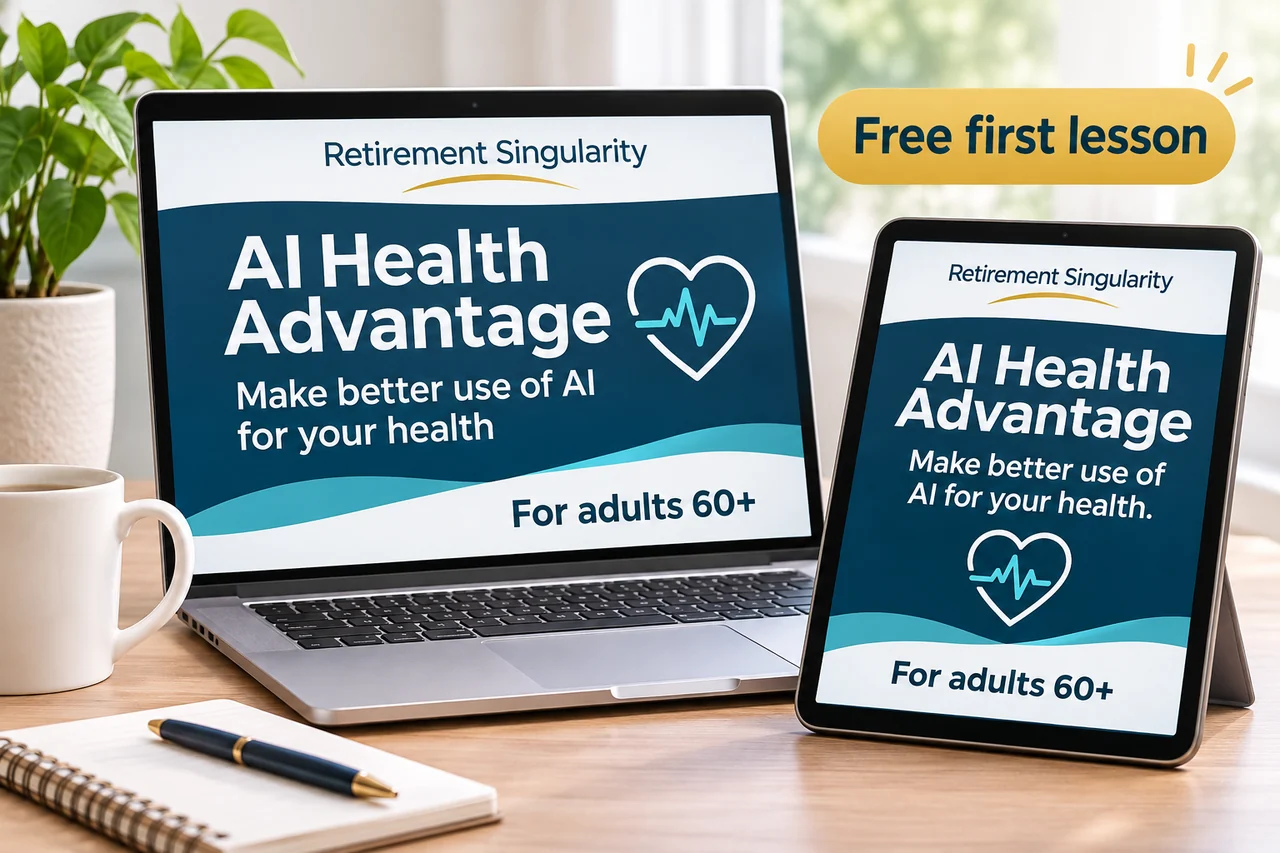
I created AI Health Advantage to help adults 60+ develop the practical skills to use artificial intelligence thoughtfully when researching health concerns.
The program covers asking better questions, checking AI’s answers, protecting your privacy, and preparing for more useful healthcare conversations.
Watch the free 25-minute lesson
No signup required to watch. The AI Health Starter Kit PDF is also available from the lesson page by optional email signup. Or explore the full AI Health Advantage course (US$27).
If you’d like to explore further, the Retirement Singularity Courses & Apps page includes the complete course and a Health Concern CoPilot tool designed to help organize questions for your clinician.
And for practical insights into how AI, longevity, and other emerging technologies may change life after 60, join my free Retirement Singularity Weekly Briefing.
Our goal isn’t to become amateur doctors. It’s to become better-informed participants in our own health decisions.
The future of healthcare may increasingly involve AI. Learning to use it wisely is something we can begin today.

About Michael Nuschke
Michael Nuschke is a Retirement Futurist and founder of Retirement Singularity. After more than four decades in retirement and financial planning, he now helps adults 60+ understand the impacts of AI, robotics, longevity, and accelerating technological change. His approach, The Living Retirement Map: Navigating the Singularity, emphasizes practical preparation through Learn. Verify. Apply.
Educational information only. Not medical or financial advice. ChatGPT is not a substitute for professional medical diagnosis, treatment, or emergency care.