The Future of Aging at Home: People, AI Companions and Robots
How people, AI companions and household robots could work together to help us stay independent at home.
About 8 minutes to read · Includes a circle-of-support worksheet
One-minute takeaway
Staying independent begins with a reliable circle of people. I expect AI companions to add conversation, reminders and coordination sooner than household robots can provide dependable physical help. My view: build your human support now, explore useful AI tools, and keep an eye on robots that can be upgraded through leasing.
The capabilities and dates discussed below are a mix of current developments and my expectations for the years ahead.
I just read a moving piece called “I’m 90 – If You Can No Longer Live Alone, Skip the Care Home and Do This”. It tells the story of Dorothy, a 90-year-old widow living in the home she shared with her husband for 42 years. Her knees and hands are weakening, she sometimes forgets why she walked into a room, and a slip in the bathtub frightened her and her children.
Dorothy tried the usual options. Moving in with her daughter left her feeling like a guest. Part-time home care helped, but the turnover was frustrating and, by her account, it cost about $2,800 a month. A care facility (about $3,100 a month) was clean and organized, but its rigid schedule took away her choices, and she left after three weeks.
What finally worked was simple and human. She offered to pick up a neighbour’s daughter from school, and the neighbours returned the favour with dinners, help ordering groceries online, and small repairs. The author of the article saw this lesson: independence does not mean doing everything alone. Build a circle of support with clear tasks and backups.
As a retirement planner for over 40 years, I’ve watched families struggle with exactly this choice. And while I agree with the “lesson” of the article, it misses something big, and it’s the subject of this blog: it doesn’t mention AI or robotics at all. Dorothy’s support circle is about to gain not one new member, but two.
A “home robot” is really two technologies
Most people picture a humanoid folding laundry. That image hides the real story. A home helper is two technologies moving at two very different speeds:
- The brain is software: conversation, memory, judgment, monitoring. It rides the exponential AI curve and gets better every few months.
- The body is hardware: motors, batteries, hands. It follows a much slower engineering curve.
Here’s the key point. For staying independent at home, I’d estimate about 80% of the value is in the brain, not the body. Falls, missed medications, loneliness, slow decline nobody notices, and coordinating care are all information problems. Folding laundry isn’t what forces people out of their homes.
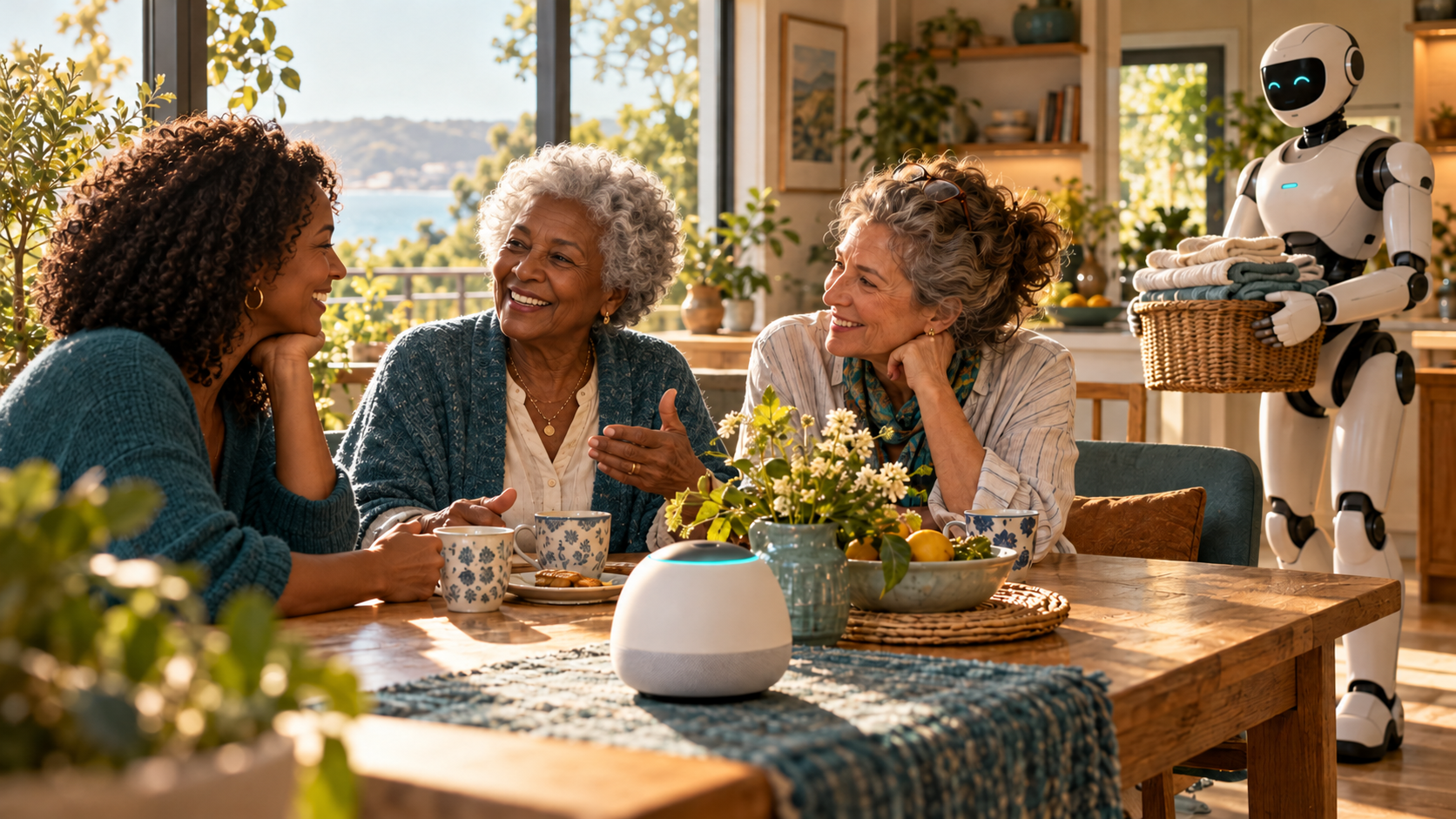
So the real product isn’t “a robot.” It’s a duo: an inexpensive AI companion that’s always there, plus a leased humanoid for physical help when it’s needed. They work together; they don’t compete.
The AI companion: the half that arrives first
Picture an advanced Alexa-style device on the kitchen counter, with a camera and a speaker but no arms. It costs about what a smartphone does, plus a subscription, and updates itself continuously. In New York State’s program, which pairs older adults with the ElliQ companion, 94% of participants report feeling less lonely (Robotics & Automation News).
I expect these companions to offer:
- Real conversation and memory. Natural dialogue that remembers months of your life and notices your mood.
- Proactive check-ins. It asks how you slept, unprompted.
- Continuous, quiet health monitoring. Changes in walking, speech patterns (an early sign of cognitive decline), bathroom frequency (a classic early sign of infection), sleep and medication habits. A daily, always-on view catches problems that a weekly visit misses.
- Agency, not just reminders. It reorders prescriptions, books a telehealth visit, orders groceries, sends your children a clear weekly summary, and calls 911 with the relevant details if something goes wrong.
For Dorothy, it could track her forgetfulness and keep her children informed without anyone hovering.
The robot: the slower half, made upgradeable by leasing
The advances in the physical robot are real but somewhat slower. As of October 2026:
- 1X NEO is the first humanoid sold for US homes: $20,000, or $499 a month. Production began in April 2026, but wide home delivery isn’t confirmed yet, and early testing found it relied on a remote human operator for most tasks (Startup Fortune).
- Tesla Optimus isn’t for sale to consumers; $20,000–$30,000 is Elon Musk’s target, not a price (Robotics Center). Figure’s CEO has said its home robot could lease for about $600 a month “near term” (report).
- Chinese makers such as Unitree and AgiBot are scaling fast and pushing prices down.
Leasing changes the math. You aren’t stuck owning a 2027 body in 2031; the lease hands you a newer model at each refresh. Meanwhile, the robot’s brain updates the same way your phone does.
By around 2030, I expect a leased robot to at least handle fetching, tidying, simple meal prep, answering the door, carrying groceries, and responding to a fall by calling for help. It may also then be able to supplement, if not replace, a human for bathing, toileting, lifting and dressing.
Dorothy’s new circle
|
Need |
Who handles it |
|
Conversation, reminders, noticing changes in health or routine |
The AI companion |
|
Prescription refills, telehealth bookings, family updates |
The AI companion |
|
Fetching, carrying, light tidying, laundry |
The robot |
|
Responding to a fall and calling for help |
Companion and robot together |
|
Real friendship, meals together, the school pickup |
The neighbours |
|
Repairs, judgement calls, love |
Family (possibly some robot repairs) |
|
Bathing, dressing, medical decisions |
Professionals (with possible help from robot) |
The technology takes the routine, repetitive and watchful work off the people in Dorothy’s life, the work behind caregiver burnout. The duo doesn’t replace the circle; it makes it sustainable.
Why the duo compounds
Here’s the exponential part. Every extra year Dorothy stays home is a year the software improves underneath her, at no extra cost. You’ll recognise the pattern: it’s a care-technology version of longevity escape velocity, where capabilities improve faster than the person declines. Each year buys time for better robots to arrive – and maybe health rejuvenation from advances in medicine.
The money
Dorothy’s own figures from the article, next to my estimates for the duo:
|
Option |
Monthly cost |
|
Care facility (Dorothy’s) |
about $3,100 |
|
Part-time home care (Dorothy’s) |
about $2,800 |
|
NEO robot lease today |
$499 |
|
AI companion, around 2030 (my estimate) |
a few hundred dollars up front, plus a modest subscription |
|
Robot lease with upgrades, around 2030 (my estimate) |
$300–$500 |
Dorothy’s income was about $1,100 a month, and the search for care cost her about $42,000 of savings. The duo isn’t a like-for-like replacement for a facility, but for someone who needs watchfulness, reminders and light help, a few hundred dollars a month is a very different equation from $3,000+.
What’s genuinely uncertain
I’m confident about the direction and order: brain first, body later. I’m less confident about dates. The real unknowns:
- How regulators treat health monitoring and medical claims
- Liability: who’s at fault when a robot drops someone or misses a fall?
- Privacy: a camera that knows your bathroom habits needs rules
- Trust: there’s a long way between “passes a test” and “trusted with your mother”
If I’m wrong about the timing, I’ll update this on the blog.
How to get ready now
- Do the article’s homework first. List the tasks getting hard and get a home safety assessment. Grab bars and a fall alert still matter.
- Build your human circle. Neighbours, family and community programs remain the foundation.
- Start with the brain. Try a voice assistant or AI companion now, for reminders, conversation and family updates. It’s the part on the exponential curve, and it’s affordable today, plus gets you accustomed to using AI for aid.
- Lease, don’t buy, the body when the time comes, so the upgrades come to you.
- Set your privacy rules in advance. Which rooms are off-limits? Who sees what, and when? Decide before a sales pitch decides for you.
The new circle of support
Dorothy’s story ends with a wise line: needing help doesn’t mean you’ve stopped being capable or deserving of choice. For the generation now in their 70s and 80s, the point of this blog post is that the choice is about to widen.
My one-line takeaway: don’t wait for the robot. The inexpensive brain on the counter is the part on the exponential curve, it needs no body, and it’s what actually keeps you independent. The leased humanoid is the slower, upgradeable helper that arrives later for the physical 20%.
Which would you try first, the companion or the robot? Tell me in the comments.
Sources
- Lee Nash, “I’m 90 — If You Can No Longer Live Alone, Skip the Care Home and Do This”, October 30, 2026
- “New York extends AI companion program in partnership with Intuition Robotics”, Robotics & Automation News, October 10, 2026
- “1X starts delivering its $20,000 Neo home robot, teleoperator and all”, Startup Fortune, October 22, 2026
- “Tesla Optimus Price & Availability (2026): Confirmed Facts vs Estimates”, Robotics Center, updated July 2026
- “Figure CEO Says Humanoid Robots Could Soon Enter Homes For $600 A Month”, May 2026
Live long, live well & prosper!
Michael
Your circle of support: a simple worksheet
Download the circle-of-support worksheet (PDF, 1 page). Free to print and share. No signup needed.
Print this page or copy these questions onto paper. Start with one task that is becoming harder, and agree on a primary helper and a backup.
| Task or need | Who can help? | Backup / next step |
|---|---|---|
| Meals and groceries | ||
| Transport and appointments | ||
| Regular conversation and check-ins | ||
| Help around the house |
Discuss together: What help do I want? Who should be contacted if I need assistance? What information am I comfortable sharing with people or devices?
If Assisted Living Options are on your mind, take one step this week: Ask one person in your circle to agree on a task and a backup plan.
Keep exploring
- Using AI for Health After 60: Start With This Free Lesson — a practical starting point for better health conversations.
- When the Scammer Sounds Like Someone You Know — protect trust and communication within your circle.
Get the free weekly briefing
Clear, practical insight on AI, longer lives and the future of retirement. One thoughtful briefing each week, plus new blog alerts. Unsubscribe anytime.
Know someone planning to stay in their own home? Share this article and use the worksheet to start a conversation.