|
RETIREMENT SINGULARITY
Your Weekly Briefing
AI, longer lives and what they mean for life after 60.
With Michael Nuschke
|
|
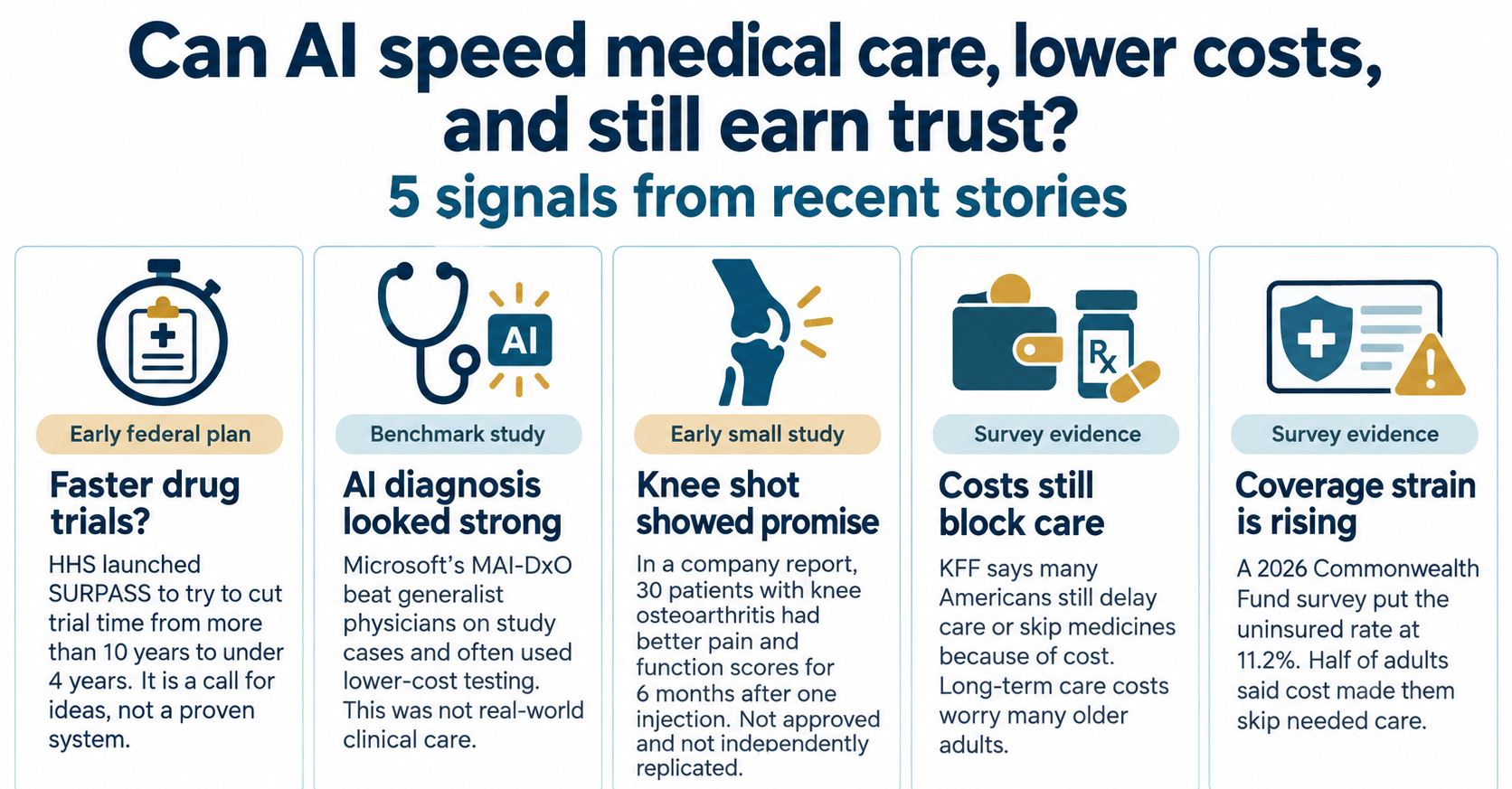
This week’s Briefing is about the gap between promise and practice. We have one major effort to speed clinical trials, one striking AI diagnosis benchmark, a small but interesting knee treatment signal, and two reminders that health costs are already reshaping retirement decisions. The common thread is simple: useful breakthroughs still have to clear evidence, access, and affordability before they matter in real life.
|
 |
|
THE BIG STORY
HHS launches SURPASS to try to cut clinical trials from a decade to under four years
What happened
The Department of Health and Human Services, through ARPA-H, announced a program called SURPASS. In plain language, it is an attempt to redesign clinical trials so drug testing can move faster, use shared trial infrastructure, and rely more on predictive models and real-time analysis enabled by advances in AI. The agency says current drug development often takes more than a decade, costs $1 billion to $2 billion, and fails most of the time. The new program is still a solicitation for ideas, not a finished system.
What it means for 60+
For adults 60+, this matters because the speed of clinical research affects when promising treatments may actually reach patients. If trials become faster and cheaper without losing rigor, more therapies could move through the pipeline sooner. A shorter trial must still prove that a treatment truly helps and does not merely look good in a model or on a surrogate endpoint.
What you should do about it
For now, this is a policy and infrastructure story in the U.S., not a treatment you can use. Yet advances in AI will continue to push the speed and efficacy of medical treatments – so it is an exciting area to keep an eye on.
Keep in perspective
This is an early federal announcement. The source describes the program’s goals, not proven results. Source URL: https://statnews.com/2026/09/30/hhs-arpa-h-clinical-trials-artificial-intelligence-surpass-program
Read the source: HHS launches SURPASS to try to cut clinical trials from a decade to under four years
|
Michael’s Take
The big pattern this week is not that AI or biotech has solved aging or disease. It is that the machinery around medicine is in the process of changing to a much faster system from discovery to clinic. That could mean quicker trials, smarter diagnosis, and better tools for pain and mobility. But for readers 60+, the real question stays the same: will it be proven, will it be available, and can people afford it when it matters? I’ll be monitoring and reporting on this kind of advance – so stay tuned!
|
|
STORY 2
Microsoft’s diagnostic AI beat generalist physicians in a benchmark
What happened
Microsoft published a peer-reviewed study in Science describing a diagnostic system called MAI-DxO and a new test setup called SDBench. The system was asked to work through cases step by step, like a doctor deciding what questions to ask and which tests to order. In the reported benchmark, it scored better than generalist physicians on the cases used in the study, and it often did so at lower cost.
What it means for 60+
The practical implication is that AI may soon help health systems sort through complex cases, suggest next steps, or reduce unnecessary testing. That could matter for older adults, who are more likely to have symptoms that are hard to interpret and more likely to see multiple doctors. But the study was done in a controlled text setting, so it does not prove the system is better than your actual care team.
What you should do about it
Watch for whether any hospital or insurer uses this kind of tool in real patients and reports its own accuracy, not just benchmark scores. If a vendor says its AI is “better than doctors,” ask better than which doctors, in what setting, and with what safeguards.
Keep in perspective
This was a benchmark study, not a clinical deployment. The authors themselves say it does not establish superiority over specialists, multidisciplinary teams, or real-world practice. Source URL: https://science.org/doi/10.1126/science.aeh7930
Read the source: Microsoft’s diagnostic AI beat generalist physicians in a benchmark
|
|
STORY 3
One shot for knee osteoarthritis showed six months of relief in a small company study
What happened
A company called Allegro reported early results for a knee osteoarthritis injection designed to restore some of the joint’s shock-absorbing function. In the report, 30 patients received one injection, and their knee pain and function scores improved over six months. Osteoarthritis is the wear-and-tear joint disease that often limits walking, stairs, and daily activity in later life.
What it means for 60+
For adults 60+, mobility is not a side issue. It affects independence, fall risk, social life, and how long a person can live well at home. A treatment that could ease knee pain for months after one shot would be welcome if it holds up in larger trials. The caution is that this was a small, company-run study without a comparator group, so we do not yet know how much of the benefit came from the treatment itself versus placebo effects or the natural ups and downs of symptoms.
What you should do about it
Treat this as encouraging but unproven. If you have knee osteoarthritis, the evidence-backed basics still matter: keep moving as safely as you can, discuss strengthening and weight-bearing exercise with a clinician or physical therapist, and follow current treatment advice.
Keep in perspective
This is early evidence from a small, uncontrolled study. The treatment is not approved, and the reported gains have not been independently replicated. Source URL: https://longevity.technology/news/knee-osteoarthritis-jab-keeps-pain-away-for-6-months
Read the source: One shot for knee osteoarthritis showed six months of relief in a small company study
|
|
STORY 4
KFF says health costs are still pushing people to skip care and skip medications
What happened
KFF (the leading health policy organization in the U.S.) updated its long-running survey note on health care costs. The new figures show that many Americans are worried about medical bills, and a large share say they skipped or delayed needed care because of cost. The note also says many adults did not take medications as prescribed because they were too expensive. For older adults, the retirement-specific worry is the cost of long-term care, including assisted living and nursing homes.
What it means for 60+
This is the most immediate retirement-related story in this edition. Even the best medical breakthrough does not help if people cannot afford the doctor visit, the prescription, the follow-up, or long-term care later on. For many households, the real stress point is not only premiums. It is the total cost of staying healthy enough to remain independent. The survey also reinforces a hard truth. Cost pressure can turn into worse health, not just financial discomfort.
What you should do about it
For US readers, use open enrollment, plan reviews, or any annual benefits check to look beyond the monthly premium. Compare prescription costs, deductibles, and coverage for the services you actually use. If you help family members, this is also a good moment to discuss who would pay for care if a serious illness or long-term care need appears.
Keep in perspective
This is survey evidence, not a clinical trial. Some of the figures come from different KFF polls and different dates, so they should not be treated as one single snapshot. Source URL: https://kff.org/health-costs/americans-challenges-with-health-care-costs/
Read the source: KFF says health costs are still pushing people to skip care and skip medications
|
|
STORY 5
The uninsured rate rose to 11.2%, and half of adults skipped needed care because of cost
What happened
The Commonwealth Fund’s 2026 survey found that the uninsured rate rose to 11.2%. It also found that half of adults said they went without needed medical care because of cost. The report ties that to the loss of enhanced ACA premium tax credits, which helped many people afford coverage.
What it means for 60+
Like we saw in the previous story, when coverage gets thinner or more expensive, people delay care, delay prescriptions, and end up sicker later. That matters not just for older adults themselves, but also for people in their 50s and early 60s who are trying to bridge the gap before Medicare. It also connects directly to longevity medicine. Longer lives are not helpful if the cost of care rises faster than savings.
What you should do about it
If you are approaching Medicare age or helping someone who is, check whether coverage changes could affect prescription access, specialist visits, or out-of-pocket exposure next year. The broad lesson is to stress-test your health budget the same way you would stress-test your retirement income.
Keep in perspective
This is a survey-based estimate and reflects a particular period and policy environment. It shows access and affordability strain, not a direct medical outcome. Source URL: https://fiercehealthcare.com/payers/uninsured-rate-climbs-112-2026-commonwealth-fund
Read the source: The uninsured rate rose to 11.2%, and half of adults skipped needed care because of cost
|
Looking Ahead
Three things to watch for; First, whether SURPASS becomes a real operating program with meaningful clinical standards. Second, whether AI diagnosis tools move from benchmark claims into real hospitals with published patient results. Third, whether health care affordability keeps worsening faster than benefits and incomes can absorb it.
|
Quick Hits
– A CAR-T medical tourism story showed how price gaps can push patients across borders (China in this example) for dramatically cheaper treatments.
– AI educational courses for older adults are drawing large sign-ups – contrary to views that say we are not interested.
|
One Practical Step
Keep an open mind to changes in medical treatments as the terrain may be changing very quickly in the years ahead.
|
A useful next step
AI Health Advantage free Module 1
This edition is about medicine changing faster, but not all at once. A short, practical module on AI and health fits naturally because it helps readers think clearly about what AI can do now, what it cannot do yet, and how to ask better questions when doctors or health systems introduce new tools.
It is useful now because readers are starting to encounter AI in diagnostics, research, and care decisions. A calm, nontechnical overview can help people separate genuine help from marketing noise.
Take the first Module free
|
|
Live long, live well and prosper!
Michael

|
Stay connected
If you want the next edition in your inbox, sign up for the free Retirement Singularity Briefing.
Was this Briefing forwarded to you? Subscribe free to receive future editions.
Subscribe free to the RS Briefing
|
|